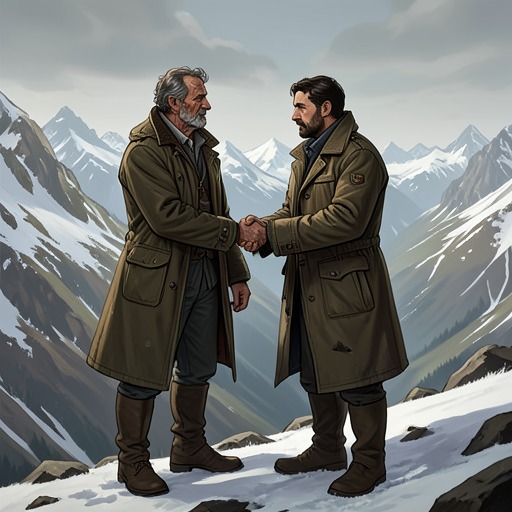
The old skis from the farmstead cellar
The Eight Mountains: A NovelThe old skis from the farmstead cellar are a long-neglected pair that Bruno turns into a means of sudden movement across the snowfields of Grenon. Their brief, exhilarating return to use links a comic display of new skill with the later mystery of Bruno’s disappearance: when Pietro suggests checking the storeroom for skis, the pair is gone, but its absence does not explain where Bruno went.
Discovery and uncertain history
Bruno says he found the skis in his uncle’s cellar while going down to fetch a shovel. They had been there for years, and he does not know who they belonged to. The narrator estimates that they are thirty or forty years old and describes their appearance as that of a military relic. Their age and uncertain ownership give them a history that predates Bruno’s use of them, but the account supplies no definite maker, owner, or earlier purpose.
The skis emerge from a cellar as objects stored out of sight and apparently unused for a long time. Bruno’s discovery is practical rather than ceremonial: he had gone for a shovel, and the skis were found along the way. Yet he immediately makes them part of his life on the mountain. Their old age does not prevent them from carrying him downhill; the contrast between their neglected past and their sudden use is central to their appearance in the story.
Bruno’s first descent
When Pietro sees Bruno above the treeline, Bruno waves and then throws himself down the slope. Only as he begins moving does Pietro realize that he is wearing skis. Bruno descends awkwardly, with his legs wide and arms open, his chest thrust forward to maintain a precarious balance. The passage gives the descent its drama through the contrast between his ungainly posture and his decisive handling of the slope.
Approaching the first larch trees, Bruno throws himself to one side and steers clear of the wood, crossing higher up toward the main gorge of Grenon. In summer, a small stream runs through the gorge; under the snow, it has become a broad slide reaching without obstruction to the lake. Bruno assesses the remaining incline, points the skis toward Pietro, and sets off again. He gathers speed in the gorge, stays upright, sweeps into the basin, brakes on the flat, and slides to a stop beside him. The old skis are not merely displayed: their movement carries Bruno through a route whose steepness and open runout make the descent consequential.
Sweaty and smiling, Bruno asks, “Did you see that?” He explains that he had found the skis in his uncle’s cellar and had begun using them only about a week earlier. Asked what is hardest, he answers, “Not looking at a tree if you think you’re about to collide with it. If you look, you’re sure to hit it—bull’s-eye.” His brief lesson is grounded in the danger he has just navigated: the skier must resist fixing attention on the obstacle he fears hitting. The skis make a new skill possible, but they do not make the descent safe or effortless.
A Christmas encounter
Pietro calls Bruno crazy, and Bruno laughs and claps him on the back. The narrator notices Bruno’s long gray beard and euphoric, brightly lit eyes; the contrast between the aged skis and Bruno’s exhilaration makes the descent feel like an unexpected burst of energy. Bruno then wishes Pietro a Merry Christmas and urges him to come along, behaving as if they had met by chance and ought to celebrate their good fortune.
Bruno picks up the skis and carries them on his back as he clears a path for Pietro along a route learned through his experiments as a skier. Their role therefore shifts within the scene: first they are the means of Bruno’s solitary descent, then objects he carries while guiding his visitor. The meeting’s warmth is expressed through action—the wave answered across the slope, the back-clap, and the shared route—not through an explanation of what the encounter means to either man.
Absence during the search
In March, after Lara tells Pietro that Bruno cannot be found, the old skis acquire a different significance. Bruno’s cousins have gone up to Barma, where the house has been buried beneath deep snow. A helicopter-borne rescue team digs down to the roof and makes a hole in the tiles, but Bruno is not inside; the recent snowfall has also erased any tracks in the surrounding area. Pietro, who was the last person to see Bruno, suggests checking whether a pair of skis remains in the storeroom. Lara reports that they are not there either.
The missing skis are a concrete absence during a search otherwise obscured by snow. Their earlier appearance has established Bruno as someone capable of descending the slope on them, and their disappearance from the storeroom makes them a possible clue. The passage does not say that the skis prove he left Barma or establish his route. Instead, they sharpen the uncertainty: neither Bruno nor the skis can be found, while the conditions on Grenon frustrate the search. The pair’s movement from forgotten cellar objects to instruments of a risky descent, and then to an absence noticed during Bruno’s disappearance, gives them a small but pivotal place in the story’s final mystery.